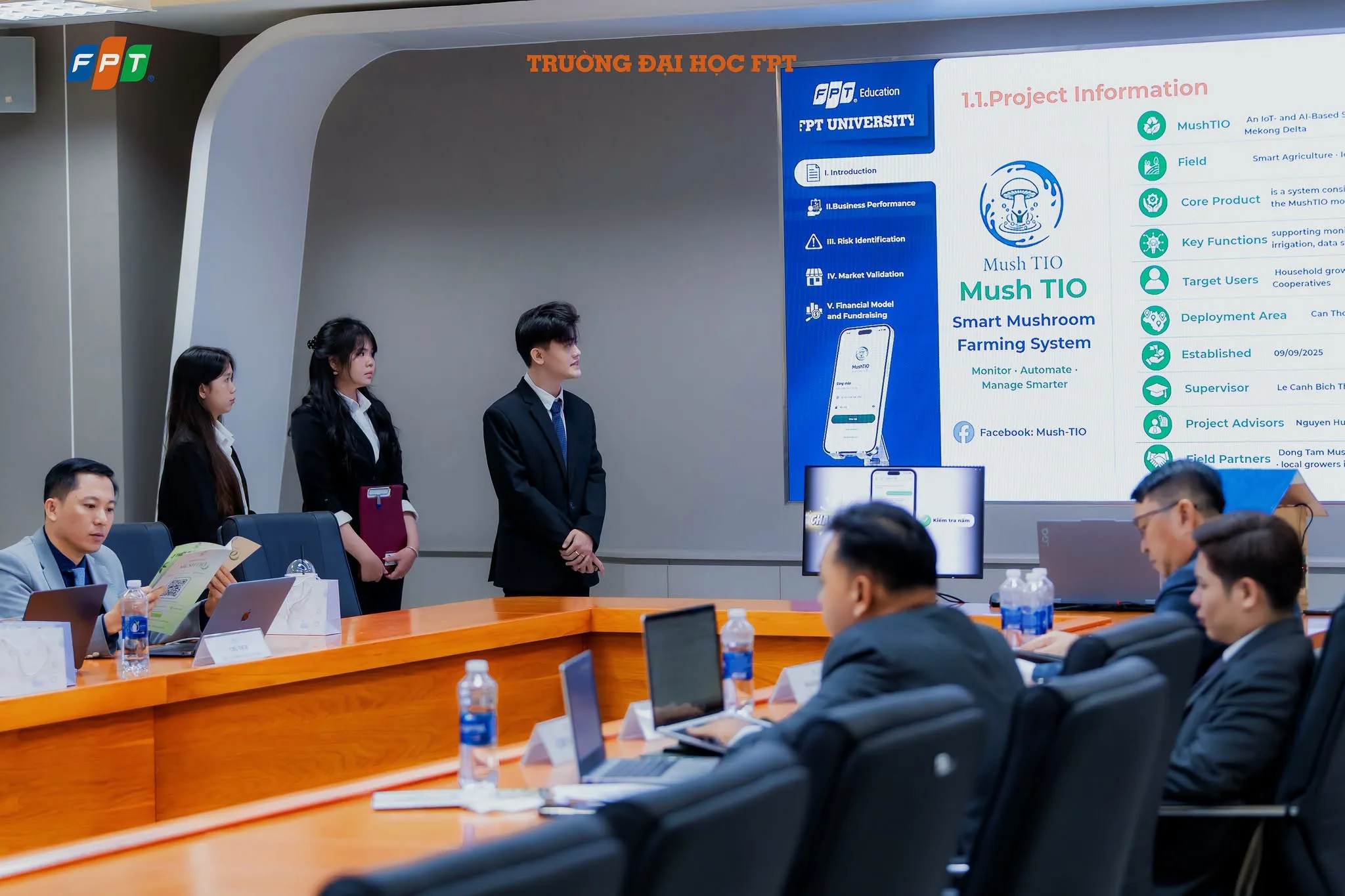
MushTIO is an IoT system developed by FPT University students, designed to monitor mushroom cultivation environments and promote smart agriculture in the Mekong Delta region.
Temperature, humidity, and ventilation are crucial factors affecting mushroom growth. Regularly monitoring these indicators helps growers detect fluctuations and adjust production conditions accordingly. However, for many small and medium-sized producers, the monitoring process still relies primarily on manual methods. Based on this practical problem, a group of FPT University students developed MushTIO – an IoT system for real-time monitoring of mushroom growing environments, aiming to bring technology closer to producers in the Mekong Delta.
MushTIO: Digitizing the monitoring of mushroom growing environments

MushTIO is a project undertaken by a group of six FPT University students, including Huynh Van Gioi – Team Leader, Tran Ngoc Thao Anh, Nguyen Nhut Quynh, Luu Yen Quynh (Business Administration K18), Tran Viet Minh and Nguyen Duy Khanh (Software Engineering K18).
Driven by the need to monitor environmental conditions during mushroom cultivation, the team chose to apply the Internet of Things (IoT) to build an automated monitoring system. Instead of having to constantly inspect each area of the mushroom house, growers can monitor indicators through a mobile application.
Specifically, MushTIO uses IoT sensors to record temperature and humidity in real time. This data is then transmitted to an application, allowing users to visually and conveniently monitor the mushroom house environment. When the readings exceed pre-set thresholds, the system can send early warnings and activate automatic irrigation.
This operating method aims to reduce manual inspection tasks while supporting growers to be more proactive when environmental conditions change. Instead of only detecting problems through direct observation, users have additional data to monitor and respond promptly.
Focus on the needs of small and medium-sized mushroom growers.
The differentiating factor that the development team aims for is MushTIO's specialization in mushroom cultivation. According to the project's direction, many IoT solutions in agriculture currently focus on common crops or large-scale production models. Meanwhile, the team recognizes that small and medium-sized mushroom growers also need technology but require a solution more suited to their production conditions and investment capabilities.
Therefore, MushTIO is geared towards serving facilities with approximately 2.000–7.000 mushroom substrates per farm, with a cost-effectiveness that is accessible to this user group. Clearly defining the target audience allows the team to focus product development on specific needs, rather than building a system that is too complex or beyond the implementation capabilities of small-scale producers.
Through a combination of environmental sensors, wireless connectivity, and a mobile application, MushTIO aims to simplify data access within mushroom farms. Growers can monitor essential metrics without having to be constantly present for direct inspection. This is a significant approach in the context of production facilities seeking more convenient and proactive management methods.
The approach focuses on integrating AI for fungal disease identification.
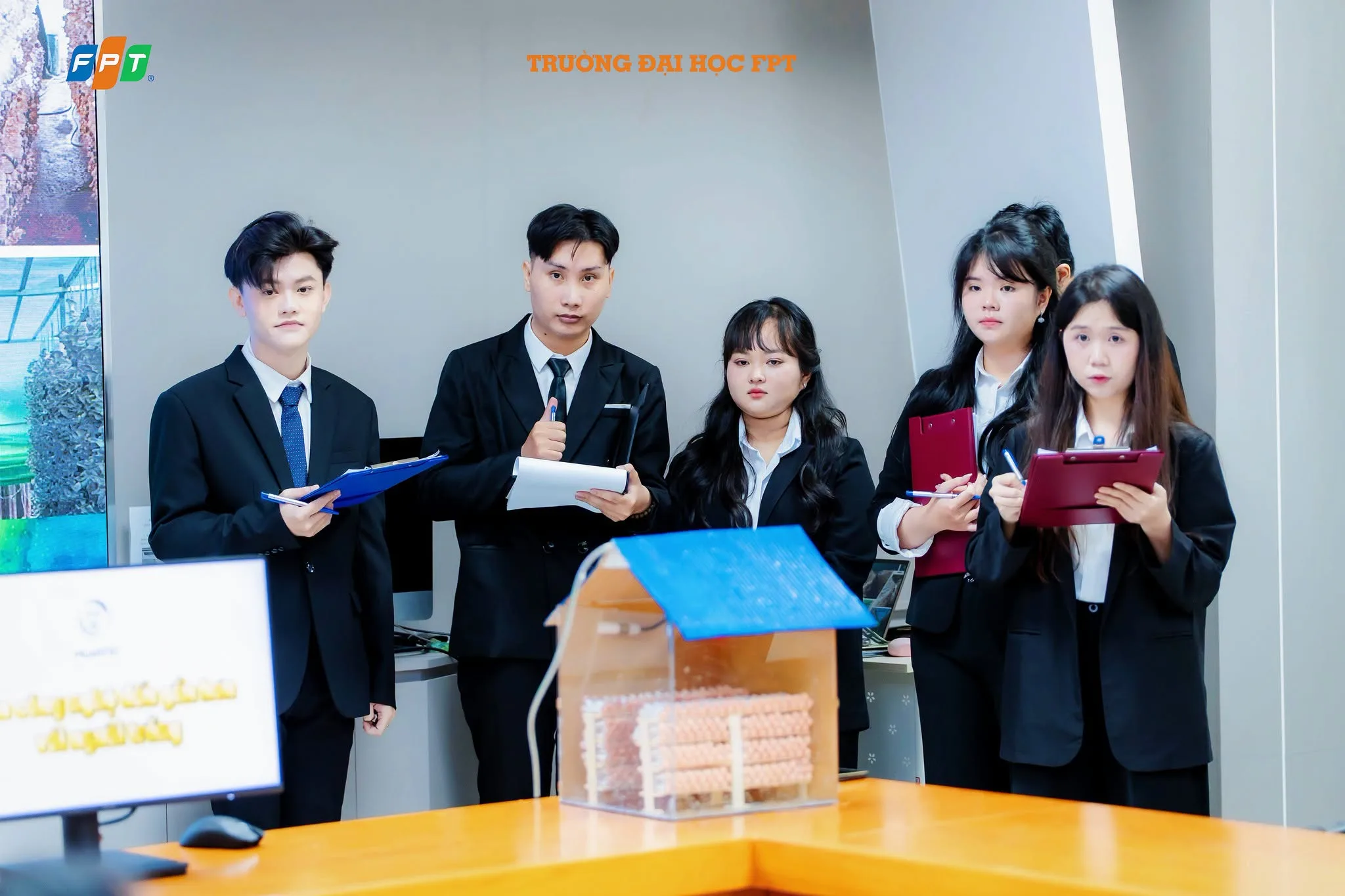
Beyond its environmental monitoring function, the development team aims to expand MushTIO by integrating artificial intelligence (AI) in the next phase. Specifically, the project focuses on developing a feature for identifying fungal diseases through images.
If further refined and tested in real-world conditions, this feature could expand the system's role from monitoring environmental parameters to assisting growers in identifying abnormal signs in mushrooms. This is a development direction aimed at supplementing information to support the care and management of production.
However, AI-based disease identification remains the project's future direction. The team needs to continue refining the solution and verifying its effectiveness before this feature can be implemented in practice. Developing in stages also gives MushTIO the opportunity to assess user needs, adjust the technology, and identify truly essential features.
From local problems to young people's technological ideas.
The idea for developing MushTIO originated from the members' observations of agricultural practices in the Mekong Delta. As young people deeply connected to the region, the group recognized limitations in agricultural production and management, and therefore wished to apply their acquired knowledge to find suitable solutions.
Instead of choosing a theoretical technological topic, the team focused on a specific need of local producers. This approach placed the user and the usage context at the center of the product development process. Factors such as the scale of the mushroom farm, operational procedures, and investment level were all considered in the system's design.
With MushTIO, knowledge of IoT, software, and management is combined in a single project. The participation of members from both Business Administration and Software Engineering fields allows the team to approach the problem from multiple perspectives: developing a technical solution while also considering the user base and application potential.
Connect with mushroom growers to perfect the product.
MushTIO's initial development has attracted interest from experienced mushroom growers. The project is now supported by Mr. Minh and Mr. Ut Nhieu, who are eager to assist the team in its development and application of the technology.
Through this connection, several mushroom growers have also expressed interest and willingness to experience the solution. This is an opportunity for the team to get closer to users, listen to the difficulties in the production process, and record feedback on how the system operates.
For a technology product aimed at agriculture, testing in a real-world environment is crucial. Feedback from mushroom growers will help the team assess convenience, ability to meet needs, and areas for adjustment. From there, MushTIO can be gradually refined to better suit local production conditions.
Bringing technology closer to agriculture in the Mekong Delta.
Starting from a specific problem in mushroom farming, MushTIO opens up an approach to applying technology to small and medium-scale agricultural production. The project shows that IoT doesn't necessarily have to start with large models or complex systems, but can originate from the practical needs of individual producers.
With a focus on further improving monitoring functions, expanding AI application capabilities, and connecting with mushroom growers, the team hopes MushTIO can become a more convenient solution for managing the production environment. The product development journey is also an opportunity for members to accumulate experience, test their knowledge, and learn how to bring technological ideas into practice.
Through this project, FPT University students demonstrate a proactive spirit in applying interdisciplinary knowledge to solve problems relevant to the community. When IoT, AI, and innovative thinking are placed within the real-world context of the local area, technology is not limited to the classroom but also has the opportunity to create practical value, contributing to promoting smart and sustainable agriculture in the Mekong Delta.