
1. Our commitment
FPT University, as an institution, systematically measures and tracks gender equity in its pay scale. The principle of “equal pay for work of equal value, regardless of gender” is applied to all faculty members and administrative staff, in line with Article 90(3) of the Vietnam Labour Code 2019 – which requires employers to ensure equal pay without gender discrimination for employees performing work of equal value – and with the Law on Gender Equality 2006.
As a member of FPT Corporation, FPT University applies the FPT Compensation and bonus policies, which states:
“FPT places strong emphasis on building a competitive remuneration policy that provides comprehensive care for employees and their families, ensuring that income is commensurate with job performance and contributions to FPT, while maintaining fairness and transparency. Employees are evaluated regularly and transparently based on the principle of ‘Do more – Get more.’”
Under this policy, income depends only on the job, performance and contribution – not on gender. Because employees are evaluated regularly and transparently against the same criteria, men and women doing the same work and achieving the same results receive the same pay. The University conducts an annual gender pay review and publishes the results openly. This report presents the results for 2025 and compares them with the previous year and with the national benchmark.
2. How we measure and track
The gender pay review is carried out once a year by the Human Resources Department using the University’s payroll data, following a consistent method so that results can be compared over time:
- Scope: all faculty members and administrative/support staff on the University payroll.
- Data source: official payroll records for the full reporting year (average monthly income, including base salary, allowances and performance-related pay).
- Indicators tracked: (i) average monthly income of male and female employees; (ii) the unadjusted gender pay gap, calculated as (male average − female average) ÷ male average; (iii) the female-to-male pay ratio; (iv) breakdown by employee group (faculty / staff) where available.
- Benchmarking: results are compared year-on-year and against the national average published by the National Statistics Office of Vietnam (NSO).
- Reporting: results are reported to the University leadership for review and published on the University website every year.
3. Results for 2025
Table 1: Average monthly income by gender at FPT University, 2025 (Unit: VND)
| Indicator | Value |
| Average monthly income – male | 34,903,031 |
| Average monthly income – female | 29,124,496 |
| Average monthly income – all employees | 31,614,734 |
| Difference (male − female) | 5,778,535 |
| Unadjusted gender pay gap | 16.6% |
| Female-to-male pay ratio | 83.4% |
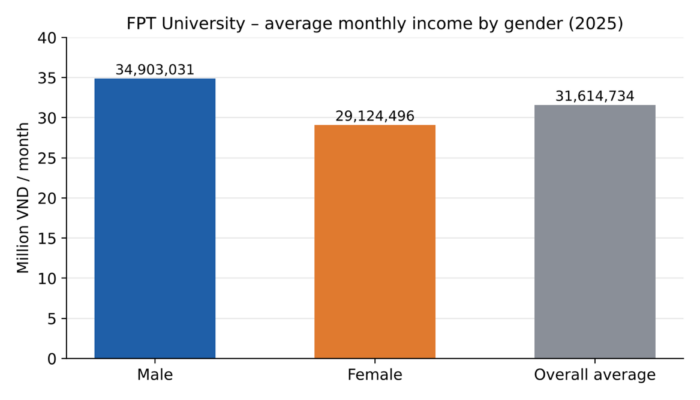
Table 2: FPT University gender pay gap compared with previous year and the national benchmark
| Group | Male (VND) | Female (VND) | Pay gap |
| FPT University 2025 – all employees | 34,903,031 | 29,124,496 | 16.6% |
| Vietnam 2025 – all workers (NSO) | 9,500,000 | 7,200,000 | 24.2% |
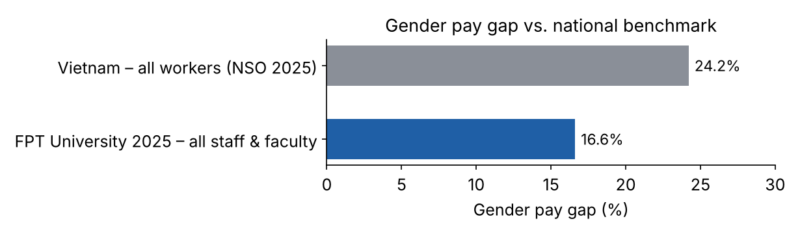
According to the NSO press release on the labour and employment situation in Q4 and full-year 2025, the average monthly income of male workers in Vietnam was 9.5 million VND and of female workers 7.2 million VND – a gap of about 24.2% (women earning about 75.8% of men’s income).
4. Findings and insights
- Smaller gap than the national level: FPT University’s unadjusted gender pay gap (16.6%) is about 7.6 percentage points lower than the national gap (24.2%); women at the University earn 83.4% of men’s average income, compared with 75.8% nationally.
- High absolute income for women: the average monthly income of female employees (29.1 million VND) is about four times the national average for female workers (7.2 million VND).
- Women are the majority of the workforce: women make up roughly 57% of the University’s employees, showing that the University is an attractive and inclusive employer for women.
5. Actions and next steps
Based on this review, FPT University will continue to strengthen gender pay equity through the following actions:
- Annual gender pay review: repeat this measurement every year with the same method and publish the results.
- Deeper analysis: from the 2026 review, break the data down by employee group (faculty/staff), job grade and management level, so that pay is compared between men and women in the same position (“equal pay for equal work”).
- Review of individual cases: where a difference between men and women in the same position and grade cannot be explained by objective factors (qualifications, experience, performance), it is reviewed and corrected in the annual salary adjustment.
- Fair evaluation, recruitment and promotion: apply the same transparent, regular performance evaluation under “Do more – Get more” to all employees, and use criteria-based recruitment, salary offers and promotion to encourage more women into senior academic and management positions.
- Awareness and training: provide gender-equality and unconscious-bias awareness for managers involved in hiring, evaluation and pay decisions.