
FPT University, as an institution, measures how its students and staff commute every year and has set time-bound, quantified targets to shift commuting towards sustainable modes. In line with FPT Corporation’s short-term goal, the university aims to reduce total emissions and greenhouse gases, including those from commuting, by 15.8% by 2030, on the path to the group’s Net Zero 2040 goal.
1. A university-wide commitment
Sustainable commuting targets are set at institutional level, not by individual clubs or campaigns. As a member of FPT Corporation, FPT University applies the emission targets published in the FPT Corporation ESG Report: a 15.8% reduction in total emissions and greenhouse gases (GHG) by 2030 in the short term, and Net Zero by 2040 in the long term.
Commuting targets are set by the university as a body under Article 28, Commitment to carbon-neutral university, of FPT University’s Sustainable Development Policy. The policy covers all operations on all campuses and all students, faculty and staff. Its current version was approved by the University President on 30 May 2026, is reviewed every year, and is administered by the Sustainable Development Goals Office.
2. How we measure commuting
FPT University runs an regular Commuting Survey across all five campuses, first in 2024. In 2025, the Ho Chi Minh City campus added a second method: counting vehicles in its parking lots against student numbers. Each survey records how people travel, how far, and how often, so that mode share and emissions can be compared year on year.
- Who is surveyed: students, faculty and staff on all five campuses. In 2024, more than 18,000 students responded over three survey rounds, plus a pilot survey of staff and faculty.
- When: once per semester (Spring, Summer, Fall), through an online form sent via the student portal and internal email.
- What is recorded: main mode of travel to campus; secondary mode (for example, electric bus to the metro station); one-way distance; trips per week; whether the vehicle is petrol or electric.
- Modes tracked: walking; bicycle or e-bike; university shuttle bus; public bus or electric bus; metro; carpool; ride-hailing (petrol or electric); private petrol motorbike; private electric motorbike or scooter; private car.
- Emissions method: annual commuting emissions = distance × trips per year × emission factor for each mode, summed over all respondents and scaled to the full campus population.
- Infrastructure data: each campus also reports shuttle bus trips and ridership, bicycle and electric-vehicle parking spaces, and charging points every semester.
3. What the data show
In the first survey in 2024, 80.1% of students travelled to campus on a private petrol motorbike, and student commuting produced an estimated 3,300 tCO₂e per year. In 2025, a parking count at the Ho Chi Minh City campus showed motorbike use falling by 25–30%.
| Indicator | Result | Year, scope and method |
|---|---|---|
| Motorbike use, HCMC students | −25–30% | 2025, Ho Chi Minh City campus, parking count against student numbers |
| Private petrol motorbike, share of student commuters | 80.1% | 2024, all campuses, survey of more than 18,000 students |
| Public bus or shared family vehicle, share of student commuters | 19.9% | 2024, same survey |
| Student commuting emissions | 3,300 tCO₂e per year | 2024, calculated from the survey |
The parking count is an independent check on the survey: it measures the vehicles actually on campus rather than what students report.
Among faculty and staff, most commute on the university shuttle bus, which runs daily between campuses and major residential areas.
4. Our targets
FPT University sets commuting targets for 2027 and 2030 against the 2025 survey results, covering each group of sustainable modes as well as total commuting emissions.
| Target | By 2027 | By 2030 |
|---|---|---|
| Student commuting emissions, compared with 2025 | −20% | −35% |
| Private petrol motorbike, share of student commuters | ≤ 64% | ≤ 52% |
| Sustainable modes combined (public transport, shuttle, carpool, electric vehicles, walking, cycling) | ≥ 36% | ≥ 48% |
| Public transport and university shuttle, share of student commuters | ≥ 20% | ≥ 25% |
| Electric two-wheelers and electric ride-hailing, share of student commuters | ≥ 10% | ≥ 18% |
| Staff and faculty using the shuttle bus or other sustainable modes | ≥ 70% | ≥ 80% |
| Annual survey response, share of students | ≥ 20% | ≥ 25% |
At the Ho Chi Minh City campus, the university also counts the vehicles in its parking lots and compares that number with the number of students. By this measure, motorbike use among HCMC students fell by 25–30% in 2025.
The 2030 commuting target (−35%) is deliberately more ambitious than FPT Corporation’s group-wide target of −15.8% by 2030, because commuting is an emission source the university can influence directly through its own services and partnerships. After 2030, commuting emissions will follow the group’s pathway to Net Zero by 2040. Campus-level targets for shuttle trips, bicycle parking and electric-vehicle charging points are set each year in the campus action plans.
The electric-vehicle targets also prepare students and staff for city policy. Hanoi’s Resolution 57/2025/NQ-HĐND introduces low emission zones from 1 July 2026: petrol motorbikes are banned from ride-hailing services in the zone, other petrol motorbikes face time restrictions and emission standards, and zero-emission vehicles are given priority. Shifting commuters to shuttle buses, public transport and electric two-wheelers now keeps their journeys to and through central Hanoi compliant as the zones expand.
5. Actions tied to each target
Each target has named actions, so progress in the survey can be traced back to what the university did.
| Target area | Actions in 2025 |
|---|---|
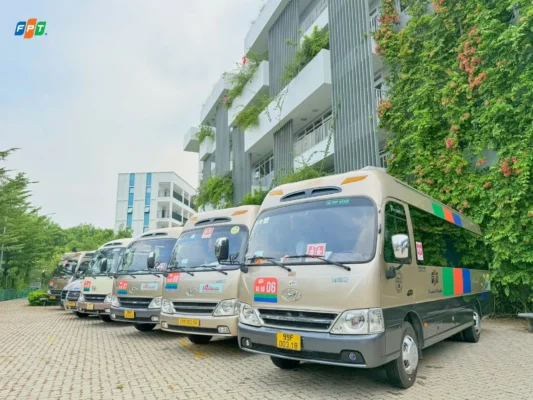
| Public transport and shuttle | Expanded shuttle bus routes and schedules (5 extra daily trips since Fall 2023); worked with city transport authorities on bus lines and stops near campuses; helped students buy Metro cards after Ho Chi Minh City’s Metro Line 1 opened on 22 December 2024 with 17 feeder electric bus routes, including one to the Hi-Tech Park area. |
| Electric vehicles | Partnership with an electric transport operator for e-bus stops serving the campus, dormitories and student housing areas; |
| Carpooling | Shared Journey matches students who live near each other; housing information system helps students find rooms close to campus |
| Walking and cycling | On-campus dormitories and nearby housing shorten trips; |
| Behaviour change | Green Transportation campaign run by 28 student clubs and official social media channels since Fall 2023; recognition for students who switch to sustainable modes |
6. Monitoring and reporting
Progress is reviewed every year and published, so the targets stay accountable.
- Each semester, the coordinating unit collects survey responses and campus transport data.
- Each December, it calculates mode share and commuting emissions for the year and compares them with the 2027 and 2030 targets.
- The Rector’s Board reviews the results and adjusts actions or campus targets if a target is off track.
- Results are published on the FPT University website and in the university’s annual sustainability report.