
In July 2025 Vietnam’s administrative map changed dramatically: provinces merged, the district level was abolished, and local government now has just two tiers: province/city and commune/ward. Thousands of commune and ward officials suddenly took on new duties, while online public services, VNeID and digital signatures demand solid digital skills. That’s when our university stepped in, with lecturers, with tech students, and with ‘learn it today, use it today’ classes.
1. Upskilling two-tier local officials in digital services: student campaigns across all 5 campuses: Hanoi, Da nang, Quy nhon, Ho Chi Minh City, Can tho
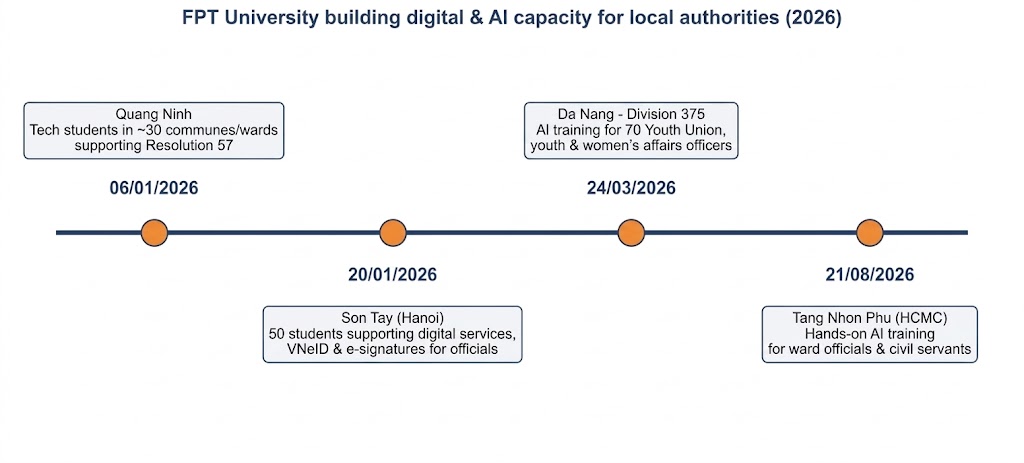
On 6 January 2026, the Quang Ninh Provincial People’s Committee, FPT Corporation and FPT University deployed technology students to nearly 30 communes and wards, including remote areas and Co To special zone, to help implement Resolution 57 on science, technology, innovation and digital transformation. Students helped run IT infrastructure, data integration centres and office software, and directly coached officials, civil servants and residents in digital skills, VNeID, digital signatures and online public services.
Just two weeks later, on 20 January 2026, our university and Son Tay ward (Hanoi) launched a team of 50 technology students, attended by the ward’s Party, People’s Council and People’s Committee leaders. Students were assigned to support digital platforms and IT in administration and procedures. According to the university, such campaigns run continuously across all five campuses with large numbers of students.
2. Building AI capacity for officials and civil servants: hands-on training, “learn it today, use it today”
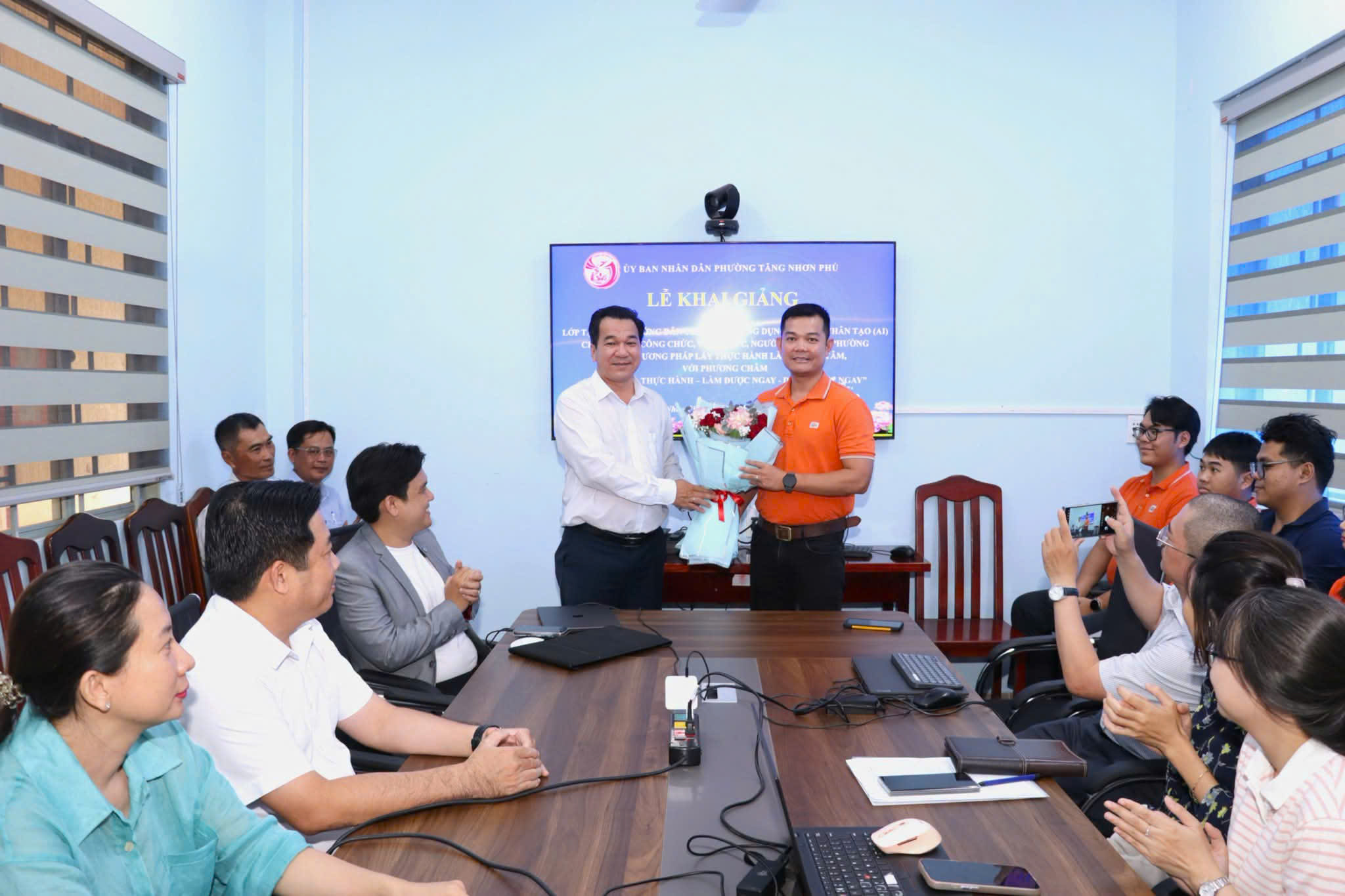
Our lecturers also teach public officials directly. On the afternoon of 21 August 2026, the Tang Nhon Phu Ward People’s Committee (Ho Chi Minh City) and FPT University opened an AI-at-work training course for more than 150 attendees – officials, civil servants and staff of the ward. The programme runs over 10 sessions, taught directly by lecturers, students and experts. The university’s Head of Information Security discussed AI’s role in national digital transformation, how to use and monitor AI tools safely and lawfully, and hands-on practice in document processing and data compilation to speed up procedures for residents.
Notably, the opening ceremony also officially launched phase 2 of the “SOS Khu phố” (Neighbourhood SOS) app – a technology product researched and built by FPT University students while working with the locality, under the guidance of a lecturer from the Faculty of Software and Data Engineering. The new phase focuses on upgrading features and putting the app into real operation in ward management, to support and connect with residents more promptly. It is part of a long-term cooperation programme between our university and the Tang Nhon Phu Ward People’s Committee, showing how the university both builds officials’ digital capacity and lets students turn academic projects into community solutions.
3. Training officials across sectors in IT and AI: institutional partnership with the Ho Chi Minh City (HCMC) Digital Transformation Centre
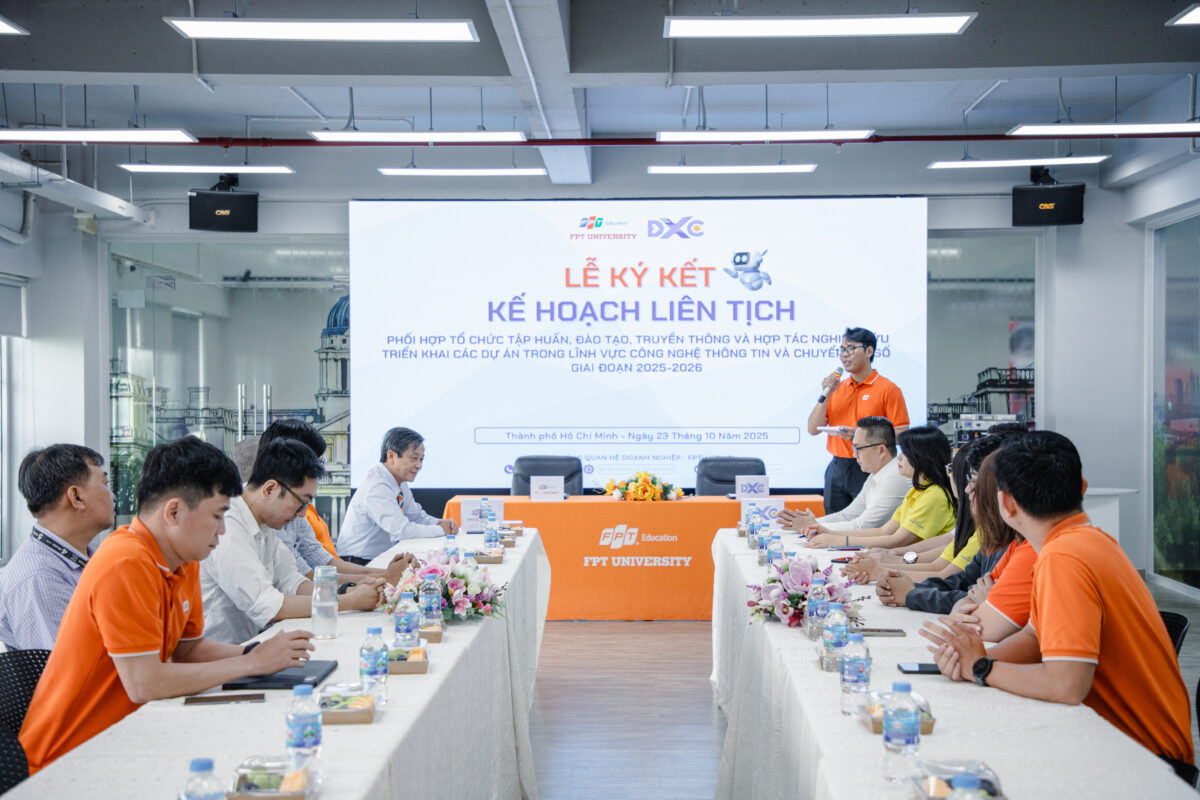
To go beyond one-off events, the university signed a partnership with the HCMC Digital Transformation Centre to run IT and AI courses for officials from many sectors, including police, commune/ward authorities and schools. It marks a shift from “campaign support” to “systematic training”, helping public servants confidently master new technology.
Conclusion: building digital capacity in public administration for better citizen services
From Quang Ninh, Son Tay and Da Nang to Ho Chi Minh City, FPT University lecturers and students are helping officials master digital technology and AI. When officials are tech-savvy, procedures become faster and more transparent, and citizens are better served through effective, accountable institutions. For students, this is the most valuable form of real-world learning.