


FPT University (FPTU), as an institution, provides free public access to its campuses, award-winning buildings, cultural installations and landscaped grounds across all five campuses in Hanoi, Ho Chi Minh City, Da Nang, Can Tho and Quy Nhon.
FPTU is a private university founded by FPT Corporation, with more than 50,000 students. Its campuses are designed as open, wall-free spaces. Members of the public can enter on foot, free of charge, to walk, exercise, and see the university’s architecture, artworks and cultural symbols.
1. Institutional commitment
Open public access is an official university policy, not an informal practice. It is set out in Aricle () Chapter () FPTU’s Sustainable Development Policy, issued by ().
Under this policy, FPTU commits to:
- Keeping campus grounds, main halls and landmark buildings open to the public free of charge.
- Offering guided campus tours on request for schools, communities, local authorities and organisations.
- Opening its halls to the public for exhibitions, fairs and community events.
- Providing an online 360-degree virtual tour for people who cannot visit in person.
2. How the public can visit
Individuals can walk in without registering; groups can book a free guided tour. All forms of access are free of charge.
| Type of access | Who | How | Cost |
|---|---|---|---|
| Walk-in visit | Any individual | Enter during opening hours: 6:00–22:00 daily. Open areas: campus grounds, main halls, Penrose halls, outdoor landscapes | Free |
| Guided campus tour | Schools, community groups, local authorities, companies | Register online: Example of Hanoi https://daihoc.fpt.edu.vn/hn/campus-tour
Tours are led by staff and student guides |
Free |
| Public events | General public | Exhibitions, fairs, concerts and community events announced on official fanpages of FPTU | Free |
| Virtual tour | Anyone, anywhere | 360-degree Virtual Tour (Example of Ho Chi Minh City campus https://viewdaihoc.fpt.edu.vn/fpt-ho-chi-minh/): navigate buildings, outdoor areas and landscaped spaces | Free |
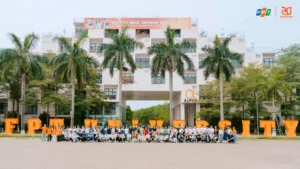
Students and teachers from B Phu Ly High School pose for a commemorative photo at FPT University
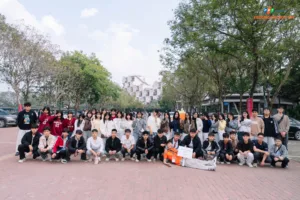
High school students join a campus tour guided by FPTU students themselves
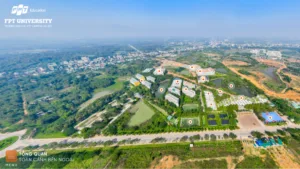
FPT University’s 360-degree Virtual Tour
3. Buildings of architectural and cultural significance
Three FPTU buildings have received national or international recognition for architecture that draws on Vietnamese culture and climate. All three are open to walk-in visitors and included in every campus tour.
Dragon-shaped administrative building – FPTU Hanoi
The Administrative Building at Hoa Lac Hi-Tech Park takes the form of a dragon, a central symbol in Vietnamese culture. Its design alternates solid and open blocks, with planting and natural ventilation suited to the tropical climate. Designed by VTN Architects (led by architect Vo Trong Nghia), it was recognised at the 42nd World Architecture Awards in 2023.
Administrative Building of FPT University Hanoi, an award-winning green architectural landmark open to visitors
Nine mountains building – FPTU Ho Chi Minh City
FPT University Ho Chi Minh City also features distinctive architecture inspired by natural forms. Its Nine Mountains building uses terraced volumes, rooftop gardens and extensive greenery to integrate the built environment with the surrounding landscape. This architectural approach is part of FPT University’s broader green and sustainable campus design philosophy.
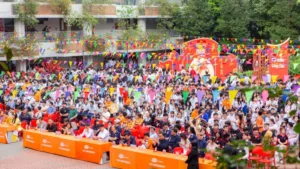
Open day at the Nine Mountains building, FPT University Ho Chi Minh City
Stacked-book building at FPT University Da Nang
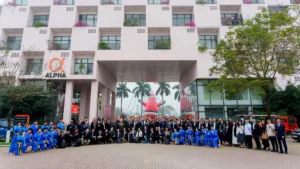
FPT University Da Nang features distinctive contemporary architecture integrated with green spaces. A prominent landmark is the stacked-book building (Alpha building), whose design is inspired by stacked books, symbolising the accumulation and development of knowledge. The building incorporates natural light, ventilation and green spaces into its design.
In April 2025, the Alpha Building was recognised among the Top 50 Outstanding Architectural Works in a national programme celebrating 50 years of national reunification. The building is accessible to visitors through FPT University’s campus tour activities, allowing the public to experience its distinctive architectural and cultural features.
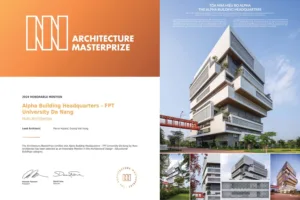
FPT University Da Nang’s Alpha Building recognised among Vietnam’s Top 50 Outstanding Architectural Works in 2025
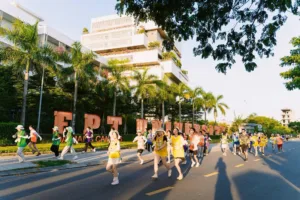
Students and visitors take part in a running activity at FPT University Da Nang, enjoying the campus’s green and open environment
4. Natural and landscaped spaces
FPTU’s green landscapes are open daily to local residents for walking, running and recreation. The Hanoi campus covers about 30 hectares at Hoa Lac Hi-Tech Park. Its award-winning Administrative Building stands beside a lake, surrounded by lawns and shade trees.
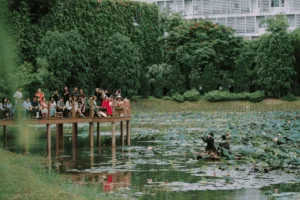
Visitors watch a traditional music performance on a boat in the lotus pond at FPT University Hanoi campus
The Da Nang campus, built in 2018 on more than 5 hectares, follows a forest-style planting model of 200 shade trees per hectare. Each teaching building holds around 160 planters with 240 plants, and its balconies are covered in bougainvillea when in bloom. The FPT complex in Can Tho, which combines the university and FPT Software Park, spans 17.4 hectares and was built with landscaped grounds, trees and a lotus pond. The Quy Nhon campus occupies a 57,308 m² site in the An Phu Thinh New Urban Area.
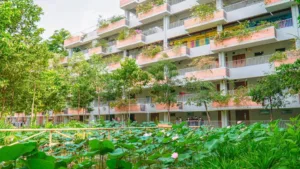
Lotus pond and planted balconies at FPT University Ho Chi Minh City, an open green space for visitors.
The campuses also host community sports events. From 18 to 20 July 2025, FPTU Da Nang hosted the FPTU Summer Jamboree, bringing nearly 3,000 Vietnamese and international students and high school students to the campus. Its programme included a community run combined with an environmental clean-up.

International students visit FPT University’s main hall during FPTU Summer Jamboree 2025
5. Cultural features and artworks
Every FPTU campus displays cultural installations in its public halls, so any visitor can see them free of charge.
Penrose hall
At every campus of FPT University, Penrose hall stands as an iconic symbol of the university’s spirit of innovation and creativity. Inspired by the Penrose triangle, the Penrose hall has Penrose-patterned floors and luxurious black-and-white or warm yellow-orange tones. Each Penrose hall is designed with an open and multifunctional layout, serving as a venue for student performances, exhibitions, conferences, and community events.
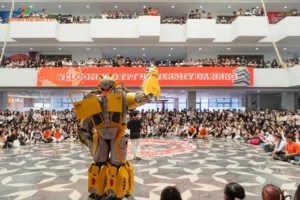
Visitors and prospective students attend an educational fair held in Penrose hall at FPT University
Beyond its academic use, the hall is also open to the public during art exhibitions, educational fairs, and community events, encouraging cultural exchange and public engagement.
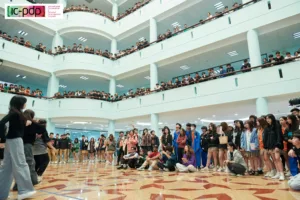
Penrose hall welcomes members of the public to a community event, serving as an open space for cultural exchange at FPT University
Bronze drums
Bronze drums symbolize the longevity of FPT University and can be seen in the main hall of each of our campuses. The drums were made of solid bronze and designed according to the Hy Cuong bronze drum of the Dong Son culture, dating from 2,500 to 2,300 years ago. They were crafted by well-known artists in the most prestigious bronze foundries in Thanh Hoa province, Vietnam. We hope that when FPT University students walk into the building, the bronze drum will remind them of the country’s origins, culture, and history, while its sounds remind them of national history and good luck.
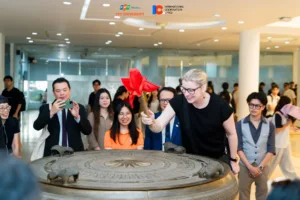
International visitors enthusiastically explore the bronze drum at FPT University, a replica of the ancient Dong Son bronze drum
Famous statues
FPTU campuses display reproductions of two internationally known sculptures, both placed in open areas that visitors can reach on foot, free of charge.
The Thinker, after the bronze by French sculptor Auguste Rodin, stands at the Hanoi, Da Nang, Quy Nhon and Can Tho campuses. The sculpture represents reflection, human aspiration, and the importance of thinking in learning and work. Its presence contributes to the university’s cultural and artistic environment and provides visitors with access to a recognised work of international artistic heritage.
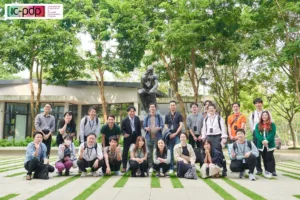
Guests gather for a commemorative photo beside The Thinker statue
Self-Made Man, after American sculptor Bobbie Carlyle’s 1987 bronze of a man carving himself out of stone, was unveiled at three campuses in late 2020: Da Nang, Ho Chi Minh City on 25 October, and Hanoi on 20 November. In Hanoi it stands on Delta Hill, a pine-covered rise at the centre of the campus.
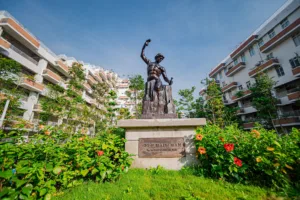
The Self-Made Man statue stands among flowering hibiscus in the landscaped courtyard of FPT University Ho Chi Minh City


