As a body, FPT University treats the safeguarding of Vietnam’s intangible cultural heritage as part of its educational mission, not as an extracurricular option. The University delivers heritage projects through three channels: compulsory courses that transmit living traditions to every student, university-funded and faculty-mentored student projects that record and digitise endangered art forms, and outreach programmes that carry these traditions to schools and the wider public in partnership with professional theatres, artisans and heritage centres. The projects below, delivered in the 2025-2026 academic year, cover national heritage, local and regional heritage, and the heritage of displaced and marginalised communities.
1. Local and regional cultural heritage: Folk performing arts of Northern and Central Vietnam
Chèo (Cheo), Tuồng (Tuong) and Water Puppetry are the folk theatre forms of Vietnam’s regions. Cheo and water puppetry were born in the villages of the Red River Delta, and Tuong is rooted in the court and folk traditions of Central Vietnam. All three are losing their audience among young people. In 2025-2026, FPT University funded and mentored a cluster of student projects that record these regional art forms in digital formats and bring them back to young audiences. The projects were delivered with professional partners, including the Hanoi Cheo Theatre, the Vietnam Tuong Theatre and the Rong Vang (Golden Dragon) Theatre, and received university seed funding (20 million VND for the Tuong project) and guidance from faculty mentors and meritorious artists.
“Neo Cheo”: anchoring Cheo theatre in the next generation
Mentored by FPT University faculty and delivered with the Hanoi Cheo Theatre, “Neo Cheo 2” (May-August 2026) brought Cheo, the folk theatre of the Red River Delta, to pupils aged 11-14. Pupils learned the art form’s history, its five classic character types (Dao, Kep, He, Mu, Lao) and its stage conventions, practised with professional artists, and tried on costumes, make-up and props. On 25 July 2026, at “Tich Cheo Reo Vui” in Hanoi, they performed classic excerpts alongside professional artists. The project reached more than 6,600 direct participants and nearly 1 million online views.

The five classic Cheo characters (Dao, Kep, He, Mu, Lao) redesigned by “Neo Cheo” students to introduce Cheo to Generation Alpha
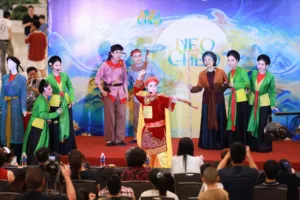
Pupils and professional artists perform Cheo at “Tich Cheo Reo Vui”, the closing event of “Neo Cheo 2”
“Tuong Tan Tich”: recording and retelling classical tuong
Working with the Vietnam Tuong Theatre and mentored by Meritorious Artists Loc Huyen and Manh Linh, the “Tuong Tan Tich” team studied classical plays such as Son Hau, Tinh Me and Dao Tam Xuan De Co and retold them for young audiences. The team produced the “Tuong Ke” podcast (more than 100,000 listens), social media series explaining tuong conventions, and the talk show and performance “Loi Tuong-Tieng Tre”, which brought 400 students face to face with tuong artists, including a tuong make-up workshop. The project reached 864,000 views in total, creating a lasting digital record of the art form and its artists.
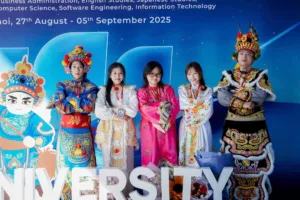
FPT University students in traditional tuong costumes and make-up, bringing classical Vietnamese theatre to their peers
Water puppetry and UNESCO-inscribed Northern folk arts
Two further projects documented water puppetry, a signature art form of the Red River Delta. “Roi Teu Nho” (January-April 2026) built an online ecosystem around Teu, the traditional narrator puppet, with the podcast “Ven Manh Tre, Nghe Chuyen Roi” and the experiential event “Thuy Dinh Vong Anh” featuring a miniature water puppet stage in a Hanoi shopping centre, reaching more than 365,000 views on Facebook. “Am Vang Roi Nuoc”, held at the Workers’ Cultural Palace in Ho Chi Minh City with artists of the Rong Vang Theatre, brought the art form to the South through live performance and five hands-on craft stations based on water puppet traditions.
The project “Dang Hinh Di San” combined 3D printing, AI-generated video and QR codes to create collectible figurines of five Northern art forms inscribed by UNESCO: Xoan singing, ca tru, Then practice, Thai Xoe dance and Quan ho Bac Ninh folk songs. Each figurine links to digital content that explains the heritage behind it. In its first month on sale (March 2026), 54 sets were bought by young people, museums, souvenir shops and educational institutions, showing that recorded heritage can also become a sustainable cultural product.
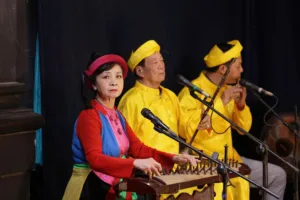
Traditional musicians perform at “Am Vang Roi Nuoc”, bringing Red River Delta water puppetry to audiences in Ho Chi Minh City
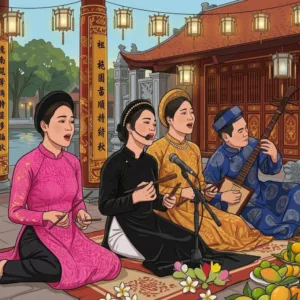
Ca tru artists reimagined by the “Dang Hinh Di San” project, which turns UNESCO-inscribed Northern folk arts into 3D figurines linked to digital content
2. National cultural heritage: Vovinam – Viet Vo Dao and Vietnamese traditional music
As part of its commitment to safeguarding Vietnam’s intangible cultural heritage, FPT University integrates two national heritage traditions into its compulsory curriculum: Vovinam-Viet Vo Dao, a traditional Vietnamese martial art, and Vietnamese traditional music played on national instruments. Every FPT University student learns both before graduating, which makes the University one of the largest institutional transmitters of these traditions to young Vietnamese people.
Vovinam-Viet Vo Dao was officially recognised as a national intangible cultural heritage by the Ministry of Culture, Sports and Tourism under Decision No. 3412/QD-BVHTTDL issued on November 10, 2023. This recognition affirms the martial art’s profound historical, cultural and educational value. Through regular training, internal tournaments and nationwide competitions, FPT University plays an active role in preserving and promoting this heritage, ensuring that its spirit of Courage, Humanity and Harmony continues to inspire future generations.
Vovinam Program at FPT University
FPT University is one of the pioneering institutions in Vietnam to integrate Vovinam into its official physical education program. The curriculum is built on three fundamental pillars: martial power, martial arts techniques and martial ethics, with martial ethics as the central focus throughout the learning process. Students are trained in forms, sparring and self-defence, and also in the philosophy of respect for teachers, compassion and perseverance that defines authentic Vietnamese martial culture.
In the 2025-2026 academic year, the University’s Vovinam training halls also served as a place to present this national heritage to the world. Visiting international delegations observed Vovinam classes and student demonstrations on campus, so the art form reached foreign partners as a living tradition practised by thousands of young Vietnamese people, and not only as a museum display.
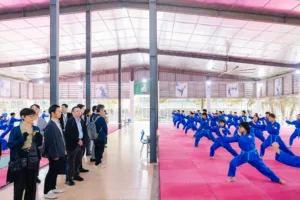
International guests observe a Vovinam class at FPT University’s Hanoi campus
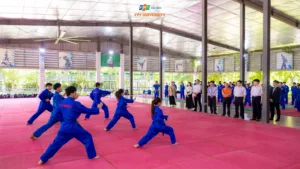
Students demonstrate Vovinam forms for a visiting delegation, presenting a living national heritage to international partners
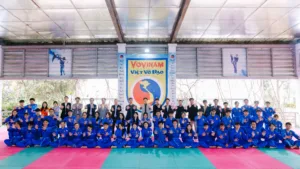
Students, lecturers and guests at the Vovinam training hall, where every FPT University student completes the compulsory Vovinam course
Traditional Music Program: every student learns a national instrument
FPT University began organising traditional music classes in 2009 and, in 2014, made traditional instruments a compulsory subject. Today every student learns to play at least one Vietnamese traditional instrument, chosen from the dan bau (monochord), dan nguyet (moon lute), dan nhi (two-string fiddle), dan tranh (zither), dan ty ba (pear-shaped lute), traditional drums and sao truc (bamboo flute). Each course runs for 60 periods (30 sessions) in classes of 15-20 students, taught by lecturers and artists with long experience in Vietnamese traditional music. To pass, students must perform two to three pieces, including folk songs, and demonstrate an understanding of Vietnamese folk and traditional music.
Around this compulsory course, the University runs a year-round programme that keeps traditional music alive beyond the classroom: traditional instrument clubs, the F-Sound competition, the “Ho Xu Xang Xe Cong” performance programme, the Cultural Heritage Week seminar series, and the “Cung Dan Dat Nuoc” exhibition on national instruments, held for five seasons from 2021 to 2025. In 2023, 1,350 lecturers and students performed together in the “Thien Am” music video, setting a Vietnamese record for the largest traditional-instrument ensemble.
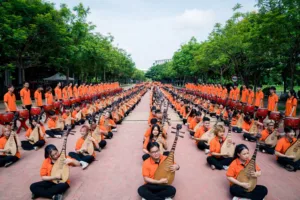
Hundreds of FPT University students perform together on traditional instruments on campus
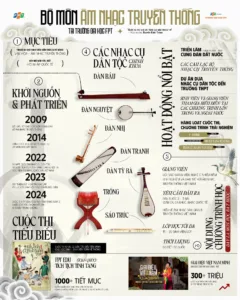
Overview of the compulsory Traditional Music course at FPT University: objectives, milestones since 2009, instruments taught and flagship activities
Promoting national heritage among the youth
The University carries both traditions beyond its own campuses. The project “Bringing Traditional Musical Instruments and Vovinam to High Schools” sends FPT University students to perform and run hands-on activities at nearby high schools. The nationwide competition “FPT Edu Tich Tich Tinh Tang”, the first traditional instrument competition for school and university students across the FPT Education system, has drawn more than 1,000 performances from thousands of students, with support from artists and artisans; its 2022 final was held at the Vietnam National Academy of Music and its 2024 final at Trung Vuong Theatre. The competition’s theme song, “Giai dieu Viet Nam minh”, has passed 300 million views across platforms and trended on TikTok, taking the sound of national instruments to a very large young audience.
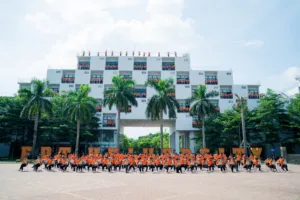
FPT University students with their traditional instruments in front of the campus, ready to carry national music to schools and communities
3. Heritage of displaced communities: The resettled Co Tu and Hat Xam
“Co Tu-Gether”: recording the culture of a resettled Co Tu community
The Co Tu people of Ta Lang and Giang Bi were moved from their original villages deep in the mountains to a resettlement area in Hai Van ward, Da Nang. Some 240 Co Tu households now live there. Relocation has weakened their crafts, communal practices and knowledge, and fewer young people are learning them.
In 2025, FPT University Da Nang students carried out “Co Tu-Gether” project. Through fieldwork with local artisans, they recorded the community’s stories, weaving, basketry, music and cuisine in a public digital archive. On 23 November 2025, the project’s event at the Da Nang Museum drew more than 300 people, who learned Co Tu crafts directly from artisan A Lang My.
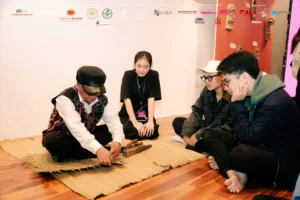
Artisan A Lang My teaches young people traditional Co Tu basket weaving at the Da Nang Museum, November 2025
“Say Xam”: preserving the song of Vietnam’s wandering people
Hat Xam was for centuries the music of displaced and dispossessed people: blind and impoverished singers who had lost their land or livelihood and wandered from market to market. In the early 20th century, rural migrants brought it to Hanoi’s trams as “Xam tau dien” (tram Xam). Today very few veteran artists still practise it.
Students at FPT University Hanoi recorded this tradition in the “Say Xam” project. They built a digital archive website on the history of Xam, its founding legend and the villages that kept it alive, and a QR-accessible virtual “Xam tau dien” in which visitors hear Xam as it was once sung on Hanoi’s trams. The team also brought young people together with master artists. With the UNESCO Traditional Arts Centre of Hanoi, they held “Hanh Trinh Am Nhac Truyen Thong” on 25 October 2025, featuring veteran Xam artist Xuan Hoach. On 15 November 2025, “Lach Ca Lach Cach” at the Ho Van Cultural Centre let young audiences learn and sing Xam alongside artists.
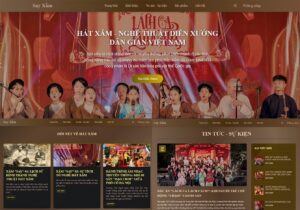
The “Say Xam” website, a digital archive of the history, legends and present-day revival of Xam singing
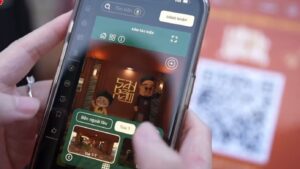
Visitors scan a QR code to enter a virtual “Xam tau dien” tram carriage and hear Xam as it was once performed on Hanoi’s trams
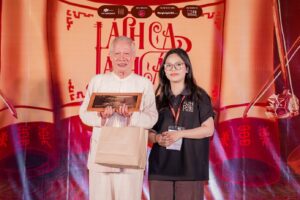
A veteran Xam artist is honoured by the “Say Xam” team at “Lach Ca Lach Cach”, where young people learned and sang Xam with master artists