FPT University welcomes the wider community to explore its museums, cultural collections and art exhibitions. From banknotes that tell stories of economic change to traditional cultural symbols and contemporary artworks, these spaces bring knowledge and creativity into public life. Through campus visits and student-led exhibitions, visitors can discover historical artifacts, engage with Vietnamese heritage and exchange ideas with students, educators and artists.
World Hyper-Inflation Banknote Museum at FPT University Ho Chi Minh
The World Hyper-Inflation Banknote Museum at FPT University Ho Chi Minh City grew out of Prof. Le Truong Tung’s long-standing interest in collecting currency. The Chairman of the FPT University Council spent more than 15 years building the collection and personally designed and arranged its displays. Introduced as Vietnam’s first museum dedicated to inflation currency, it explores the question “Hyper-Inflation – What’s the Point of Having Lots of Money?” through the banknotes themselves.
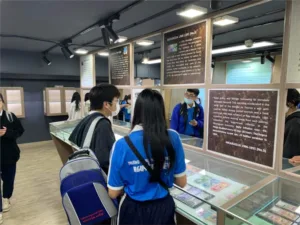
Students read an information panel on Nicaragua’s 1986–1991 hyperinflation beside display cases of banknotes at the World Hyper-Inflation Banknote Museum
The museum presents more than 300 banknotes with denominations of one million or above, from nearly 30 countries across almost a century, from 1921 to 2019. Examples from Germany, Hungary, Argentina, Bolivia, Vietnam, Yugoslavia and Zimbabwe reveal the geographical breadth of the collection. Together, these objects provide a tangible record of how different societies have experienced inflation and changes in the value of money.
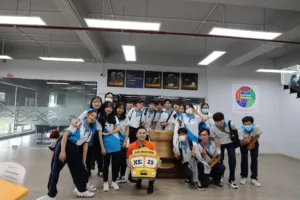
A visiting school group gathers outside the museum during a campus visit
Alongside their economic significance, the banknotes preserve the visual details of the periods and places in which they circulated. Their denominations, printed designs and historical context invite visitors to look beyond the numbers and consider currency as a record of social change. Displaying them together makes it possible to compare objects from different countries and understand why even an exceptionally large face value may represent limited purchasing power.
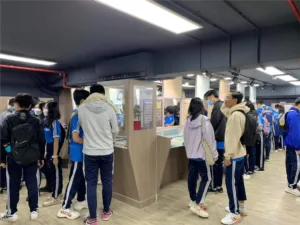
Groups of visitors explore the museum’s display cases and learn about inflation through historical banknotes
The museum serves as both an educational collection and a cultural destination for the community. School groups and other campus visitors can examine the exhibits at close range, read the accompanying explanations and discuss what the objects reveal about everyday life during periods of monetary instability. These encounters connect classroom concepts with physical evidence, encouraging curiosity about economic history and appreciation of the value of preserving historical currency for future learners
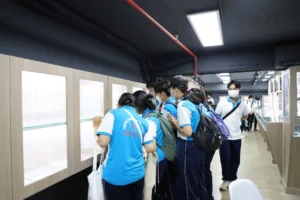
Students gather along the banknote displays to study the collection during a museum visit
“Toads” Museum at FPT University Hanoi
At FPT University Hanoi, the “Toads” Museum introduces visitors to a familiar Vietnamese cultural symbol and the university’s distinctive identity. Its collection of toad figures gives physical form to a mascot that appears throughout campus life, from everyday language to the Golden Toad distinction awarded to outstanding students.
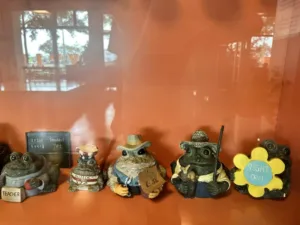
Toad figurines on display at FPT University Hanoi illustrate the variety and playful character of the collection
The toad carries associations with learning, perseverance and hopes for prosperity in Vietnamese cultural life. By presenting this symbol through objects of different shapes and designs, the museum creates an approachable setting for conversations about folklore, craftsmanship and education. Visitors can explore how a traditional motif has become part of a contemporary university community.
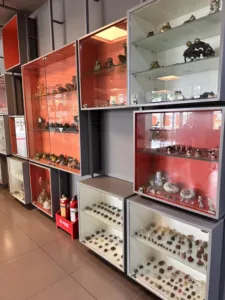
Display cabinets present toad figures of different sizes and designs at FPT University Hanoi
The museum also features visits by guests from outside the university, including international delegations. Sharing the collection through campus visits gives these audiences an opportunity to encounter Vietnamese cultural imagery while learning about FPT University’s educational environment.
Exhibition “Cung Dan Dat Nuoc” Season 5
The fifth season of “Cung Dan Dat Nuoc” (Melodies of the Nation) brought traditional musical instruments to students, staff and visiting guests at FPT University Ho Chi Minh City in March 2025. Organised in connection with FPT’s community activities, the exhibition welcomed hundreds of visitors, including international representatives, and created opportunities to explore musical heritage through both observation and participation.
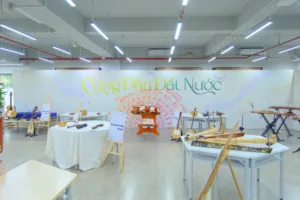
The exhibition brings different families of traditional musical instruments together in an accessible display space
More than 100 instruments and exhibits introduced the diversity of traditional music, including the dan bau, dan nguyet, dan tranh, bamboo flutes, t’rung and gongs. Instruments from Nepal and Bhutan added an international perspective. Visitors could try instruments and learn from demonstrations, connecting the objects on display with their sounds and performance traditions.
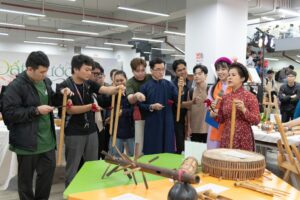
Participants explore traditional percussion instruments with guidance during the fifth season of “Cung Dan Dat Nuoc”
By combining a physical collection with direct musical experiences, the exhibition made heritage easier to understand and enjoy. It also brought external guests into the university’s cultural space, strengthening the role of the campus as a place for shared learning and exchange.
Exhibition “Sac Nam Thau Kieng”
“Sac Nam Thau Khieng” introduced Southern Vietnamese glass painting to the public through a multimedia exhibition developed by the 7Night student group from FPT University Ho Chi Minh City. Held from 8 to 10 August 2025, the exhibition followed workshops that invited participants to discover the techniques and cultural stories behind this folk art.
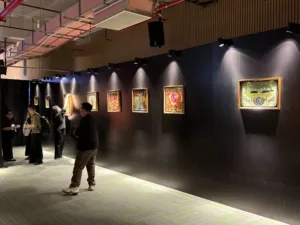
Visitors explore framed glass paintings within the exhibition space of “Sac Nam Thau Kieng”
The exhibition combined traditional glass paintings with contemporary installations, sound, projected imagery and interactive experiences. Visitors were encouraged to look closely at the artworks, engage with changing visual effects and contribute to a shared glass painting. A documentary element added the voices and memories associated with the craft.
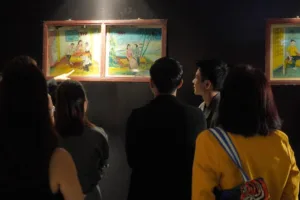
A group of visitors discuss a glass painting, bringing close observation and conversation into the exhibition experience
These activities created several ways to engage with the same heritage, from viewing original objects to exploring contemporary interpretations. The student-led project extended cultural engagement beyond the classroom and offered the wider community a setting in which to encounter, discuss and appreciate a regional artistic tradition.
Exhibition “Nu Thoi”
“Nu Thoi” welcomed the public at Toong IPH in Hanoi from 28 November to 7 December 2025. Created by Multimedia Communications students from FPT University Hanoi, the exhibition used art to explore women’s experiences across generations. Its location outside the campus brought a university student initiative into a wider urban cultural setting.
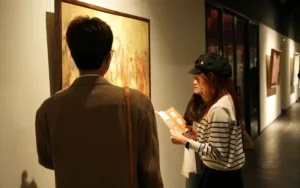
Visitors view and discuss a painting at “Nữ Thời”, an exhibition exploring images and experiences of Vietnamese women
The exhibition presented 11 works across different media. Its “Thời Ký Ức” and “Thời Kiến Tạo” spaces connected reflections on memory and tradition with contemporary perspectives. Painting, installation and video offered different ways for visitors to engage with questions of identity, everyday labour and personal expression.
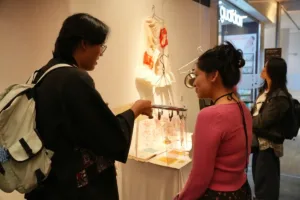
Visitors encounter an installation at “Nữ Thời”, where different artistic media encourage individual responses
Working with artists enabled the students to bring artwork into a public exhibition and introduce them to audiences with varied levels of art knowledge. The project encouraged viewers to begin with their own observations and feelings, helping make engagement with art more approachable.
Together, these museums and exhibitions demonstrate how campus collections and public cultural projects can widen access to artifacts and art. They give visitors opportunities to learn from objects, exchange ideas and take part in the cultural life surrounding the university.