


A good university listens not only to its students and lecturers but also to the people who live and work just outside its gates: residents around campus, the ward/commune authorities where it operates, and local civil society organisations, alongside employers, alumni and education regulators. At FPT University this listening is set out in policy: the University has adopted a policy defining the mechanisms and forums for these groups to take part, with processing deadlines and a responsible unit.
Who the local stakeholders are – and the mechanism they use
Our university clearly identifies three groups of local stakeholders: residents and communities around its campuses; local government (ward/commune, district, province/city); and representatives of civil society and community organisations (including groups representing vulnerable people). To give these groups a real voice in University decisions, FPT University sets out in policy a framework of mechanisms: a Local Community/Stakeholder Advisory Council; public forums and consultation sessions ahead of decisions affecting the locality; coordination mechanisms with local authorities; and open feedback channels for local residents and organisations. This framework builds on the Partnership Relations procedure the ISO 21001:2018 Standard already in use, and is being extended to local groups.
A written policy on stakeholder participation in decision-making
Since 2019 our university has applied ISO 21001:2018 – the management standard designed for educational organisations – as its quality-assurance framework. On that basis it issued the “Partnership Relations Process” (QT-10/HDCV/FE), which defines stakeholders’ roles in decision-making on teaching and learning. The policy was created in 2006 and last reviewed in 2025, a long-standing, regularly updated mechanism, not a one-off.
Identifying external stakeholders, including government
Following ISO guidance, the university maps eight stakeholder groups – learners, staff, parents, government, external providers, suppliers, the labour market and competitors – and rates each group’s interest and form of participation: involved, consulted, represented or checked. At university level, government is rated “Involved”, while the labour market – employers – has high interest and direct involvement.
Table 1. Levels of interest and participation of stakeholders (ISO 21001:2018; Interest: High (H), Medium (M), Low (L). Participation: Involved (I), Consulted (C), Represented (R), Checked (Ch)
| Category | Learners | Staff | Parents | Government | Ext. providers | Suppliers | Labour market | Competitors |
| University, College | H I | H I | L C | M I | M C | M Ch | H I | H Ch |
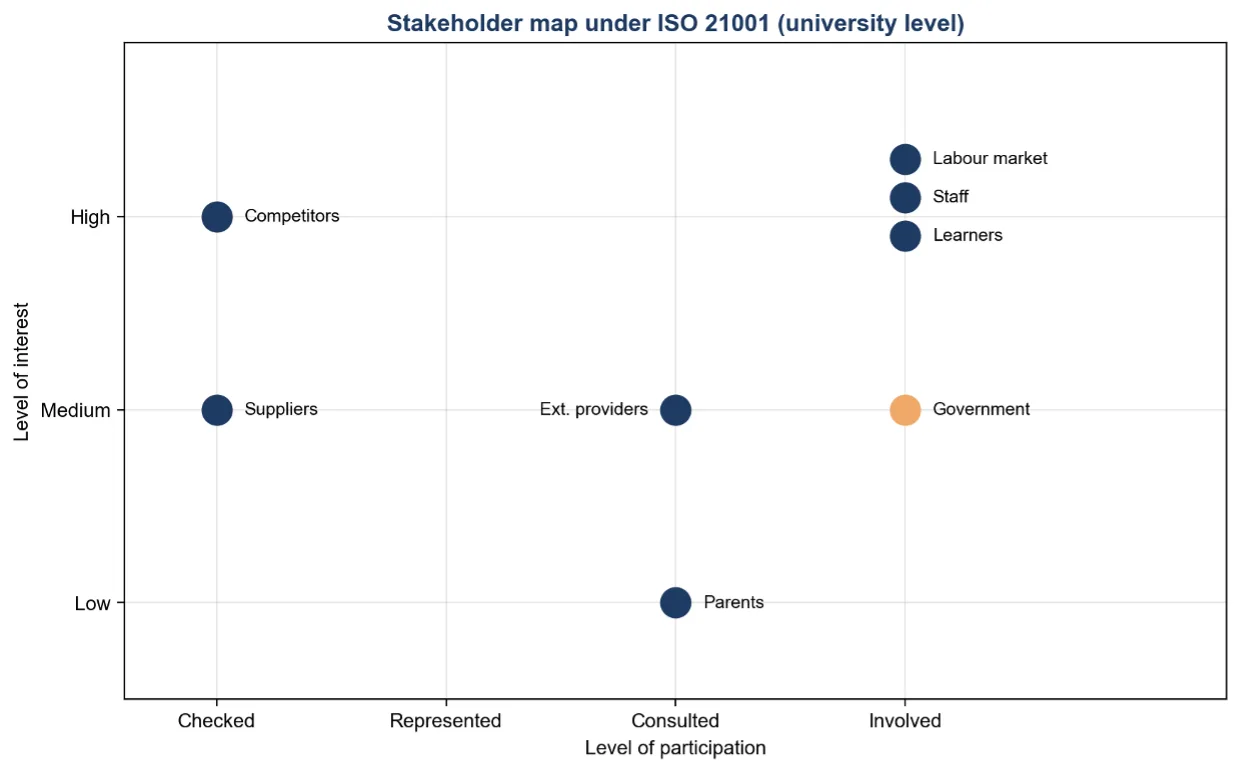
Figure 1. Visual map of Table 1: eight stakeholder groups under ISO 21001 at university level, government rated “Involved”
With employers, the university runs the iCASE model (Internship – Co-research – Academic – Scholarship – Employment): partners host interns, co-research, give academic input, fund scholarships and recruit. This brings the labour market’s voice straight into how programmes are designed.
Consultation channels: regular surveys and open feedback
External input is collected systematically: an annual employer survey on programmes, employers’ evaluation of students after on-the-job training (OJT), an alumni survey 12 months after graduation, plus internal surveys of students and staff. The survey forms are published online. Anyone can also send general feedback to [email protected], or directly to academic heads, vice rectors or the rector.
Table 2. Stakeholder survey system (forms published online)
| Stakeholder | Instrument | Purpose | Timing |
| Employers | Employer Survey | Programme feedback | Annually |
| Employers | OJT Survey on Students | Student skills | After OJT |
| Alumni | Alumni Survey | Programme & employment | 12 months after graduation |
| Students | Satisfaction, lecturer evaluation | Learning experience | End of course, final year |
| Staff | Satisfaction, programme reports | Support, syllabi | Annually, week 13 |
From input to decision: a time-bound PDCA loop reporting to leadership
What makes the mechanism “meaningful” is that feedback doesn’t sit in a drawer. Every survey follows the Plan-Do-Check-Act (PDCA) cycle. Within 7 working days of closing a survey, the responsible unit reports to the Board of Directors and the Board of Management, with sample size, responses, scores per criterion and a 3-year comparison, and sends results to relevant departments for a review meeting and corrective and preventive actions.
Units then propose improvements, implement them, and track and report back to leadership. The procedure is published on the website, the internal QA system and the FAP system. In short: external input → time-bound report to leadership → university action → follow-up.
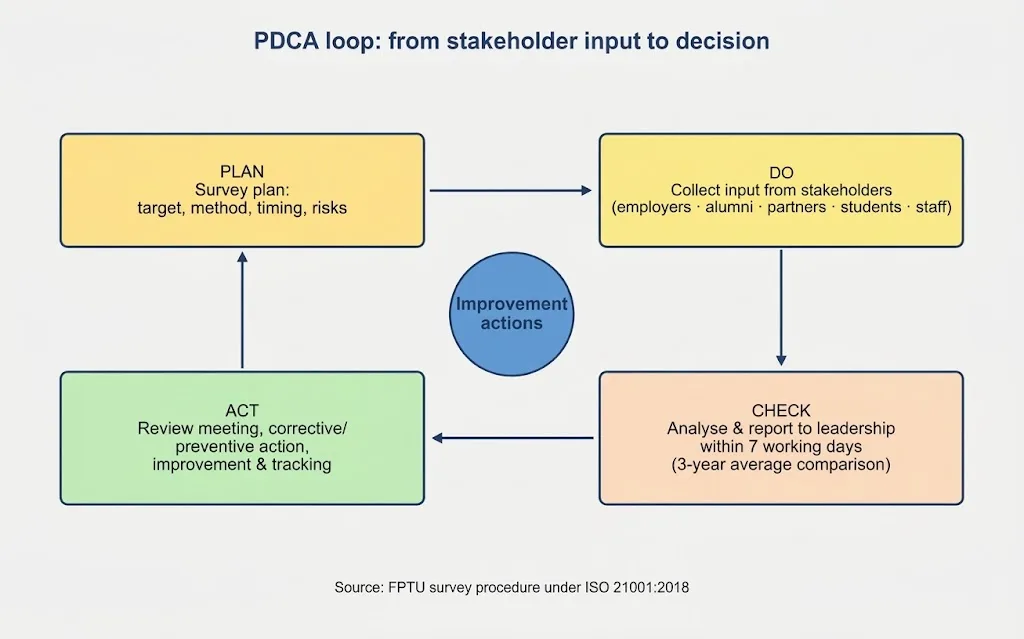
Figure 2. PDCA loop: stakeholder input reported to leadership within 7 working days and turned into improvement actions
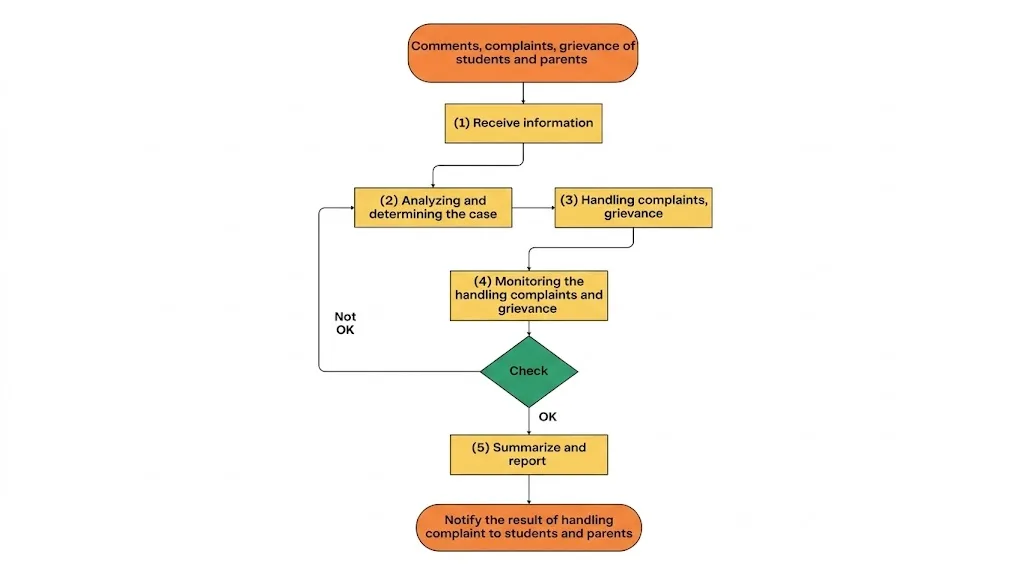
Figure 3. Feedback and complaint handling process
Engagement with local government: AI training for Tang Nhon Phu ward officials
Beyond surveys, our university works directly with the authorities where its campuses are located. On the afternoon of 21 August 2026, the People’s Committee of Tang Nhon Phu ward (Ho Chi Minh City) and FPT University co-organised a hands-on AI training course for ward officials, civil servants and staff, under the motto “Learn AI by doing – use it right away”. Attendees included leaders of the ward’s Culture and Society Division and the university’s Head of Partnership Relations.
The university’s Head of Information Security and a guest expert trained ward staff on AI’s role in digital transformation, on using and monitoring AI tools safely and lawfully, and in hands-on practice to process documents, compile data and speed up procedures for residents. The involvement of the Partnership Relations Office, the unit that runs the “Partnership Relations Process” (QT-10/HDCV/FE), shows local government is engaged through the university’s formal partnership channel. It is a two-way relationship: the locality states its needs, and the university shapes community-facing programmes accordingly.
When a local request shapes what the university does
A sign of an effective listening mechanism is when a local-government request shapes the university’s community-facing work. For example: prompted by the needs and request of the People’s Committee of Tang Nhon Phu ward on grassroots digital transformation, FPT University’s software-engineering lecturers and students researched and developed the “SOS Tang Nhon Phu” app – letting residents report urban incidents, track resolution and look up procedures; the app was launched by the ward People’s Committee and FPT University on 8 January 2026. This is a case of a locality’s needs shaping the university’s products and activities. Under the policy, such requests and inputs are minuted, entered into the PDCA loop and reported to leadership within 7 working days; the University publishes its forum schedule and consultation summary – in the spirit of SDG 16 on participatory decision-making.




