


FPT University (FPTU) is a private school founded by an enterprise, FPT Corporation, in Vietnam. Now, it has five campuses in the North, Central, and South of Vietnam, with a large training scale of over 50,000 students. The green FPTU campus has been a no-wall campus from the beginning, open to community members and visitors to enter and exit freely on foot. All people can access it for free to take advantage of the beautiful green environment of the school for leisure or exercise.
Public access through campus tours and virtual tours
FPT University applies an open-campus approach that allows members of the public to visit and experience its campus environment. The university regularly welcomes external visitors and organizes campus tours, providing opportunities for visitors to explore representative university facilities and campus landscapes.
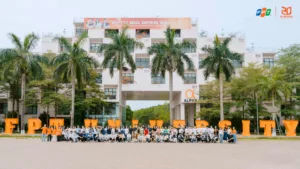
Students and teachers from B Phu Ly High School pose for a commemorative photo at FPT University
If representatives from companies, local authorities, and so on would like to visit the campus, feel free to register through the link https://daihoc.fpt.edu.vn/truong-thanh-vien/dang-ky-tham-quan/ to receive the support and guidelines or introduction about the campus of our tour guides.
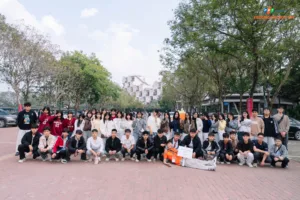
High school students join a campus tour guided by FPTU students themselves
In addition, FPT University provides a 360-degree Virtual Tour, allowing members of the public to explore the campus remotely. The virtual platform provides an interactive overview of the campus and enables users to navigate between different locations and view university buildings, outdoor areas and landscaped spaces.
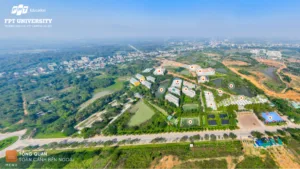
FPT University’s 360-degree Virtual Tour
Public access to culturally and architecturally significant buildings
FPT University incorporates distinctive architectural buildings and features that contribute to the cultural and visual identity of its campuses. These spaces are made accessible to members of the public as part of the university’s open-campus approach and Campus Tour programme.
Alpha building – A Dragon-shaped building at FPTU Hanoi
A prominent example is the Dragon-shaped Administrative Building at FPT University Hanoi, located at Hoa Lac Hi-Tech Park. The building was designed with a distinctive arrangement of solid and void blocks, integrated with vegetation and natural ventilation. Its architectural design has received international recognition, including recognition at the 42nd World Architecture Awards. The building and its surrounding landscape form one of the most distinctive architectural landmarks of the FPT University Hanoi campus.
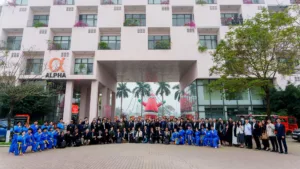
The Administrative Building of FPT University Hanoi, an award-winning green architectural landmark open to visitors
Green hill building at FPTU Ho Chi Minh City
FPT University Ho Chi Minh City also features distinctive architecture inspired by natural forms. Its Nine Mountains building uses terraced volumes, rooftop gardens and extensive greenery to integrate the built environment with the surrounding landscape. This architectural approach is part of FPT University’s broader green and sustainable campus design philosophy.
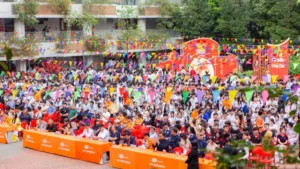
Open day at the Nine Mountains building, FPT University Ho Chi Minh City
Stacked-Book Building at FPT University Da Nang
FPT University Da Nang features distinctive contemporary architecture integrated with green spaces. A prominent landmark is the Alpha Building, whose design is inspired by stacked books, symbolising the accumulation and development of knowledge. The building incorporates natural light, ventilation and green spaces into its design.
In April 2025, the Alpha Building was recognised among the Top 50 Outstanding Architectural Works in a national programme celebrating 50 years of national reunification. The building is accessible to visitors through FPT University’s campus tour activities, allowing the public to experience its distinctive architectural and cultural features.
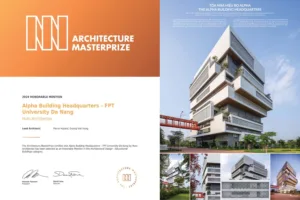
FPT University Da Nang’s Alpha Building recognised among Vietnam’s Top 50 Outstanding Architectural Works in 2025
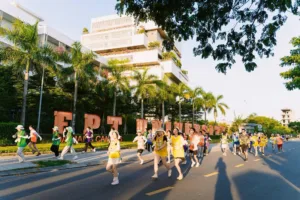
Students and visitors take part in a running activity at FPT University Da Nang, enjoying the campus’s green and open environment
Public access to cultural features
Penrose Hall
At every campus of FPT University, Penrose Hall stands as an iconic symbol of the university’s spirit of innovation and creativity. Inspired by the Penrose triangle, The Penrose Hall has Penrose-patterned floors and luxurious black-and-white or warm yellow-orange tones. Each Penrose Hall is designed with an open and multifunctional layout, serving as a venue for student performances, exhibitions, conferences, and community events.
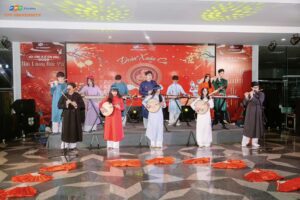
Beyond its academic use, the hall is also open to the public during art exhibitions, educational fairs, and community events, encouraging cultural exchange and public engagement.
Bronze drums
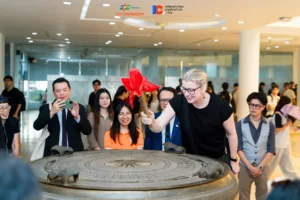
Bronze drums symbolize the longevity of FPT University and can be seen in the main hall of each of our campuses. The drums were made of solid bronze and designed according to the ancient Dong Son’s Hy Cuong bronze drum, dating from 2,500 to 2,300 years ago. They were crafted by well-known artists in the most prestigious bronze foundries in Thanh Hoa province, Vietnam. We hope that when FPT University students walk into the building, the bronze drum will remind them of the country’s origins, culture, and history, while its sounds remind them of national history and good luck.
Famous statues
FPT University also houses The Thinker, a reproduction of the renowned sculpture by French artist Auguste Rodin. The sculpture represents reflection, human aspiration, and the importance of thinking in learning and work. Its presence contributes to the university’s cultural and artistic environment and provides visitors with access to a recognised work of international artistic heritage.
Student visits to heritage sites and application of knowledge to heritage conservation
Beyond opening its campuses to the public, FPT University organises field trips that bring students to historical relics and heritage sites, and encourages them to apply what they learn to preserving and promoting these sites.
Students take part in field trips such as “Surveying the context of the K20 relic site and Huong Son Pagoda” in Da Nang. At the K20 Revolutionary Base and the nearby Huong Son Pagoda, students explore the relic areas, exhibitions and architecture, and learn the historical stories behind each place. These visits help them understand the value of heritage and raise their awareness of the need to protect it.
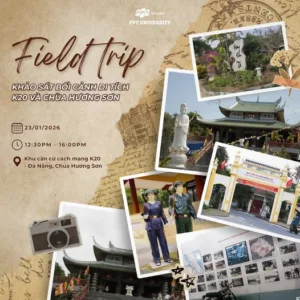
Field trip to the K20 relic site and Huong Son Pagoda organised for FPT University students
Students also turn their heritage experiences into practical solutions. ReHistoria, a graduation project by FPT University students, is an augmented reality (AR) application that recreates historical monuments such as Ngo Mon Gate of the Hue Imperial Citadel at 1:1 scale, allowing users to explore the structure and interact with 3D artefacts. All reconstructions are based on historical documents and were verified with support from experts at the Hue Monuments Conservation Centre. The project has won several startup awards and received investment to continue development, helping to digitally preserve heritage and make it accessible to people who cannot visit in person.
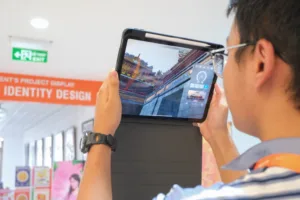
A user experiences the ReHistoria AR application, viewing a 1:1 reconstruction of Ngo Mon Gate
Through these activities, students not only visit and learn from sites of cultural significance but also contribute to documenting, preserving and sharing them with the wider public.




